Your COD RTO Rate Is Not a Payment Problem. It's a Time Problem
Every Indian D2C founder knows the number. Somewhere between 25% and 35% of your COD orders come back undelivered. Your prepaid orders? Maybe 2–8%. The gap is so large and so consistent that the entire industry has drawn a single conclusion: COD customers are lower-intent, less committed buyers. The payment method is the problem.
That conclusion is wrong. Or at least, it is dangerously incomplete.
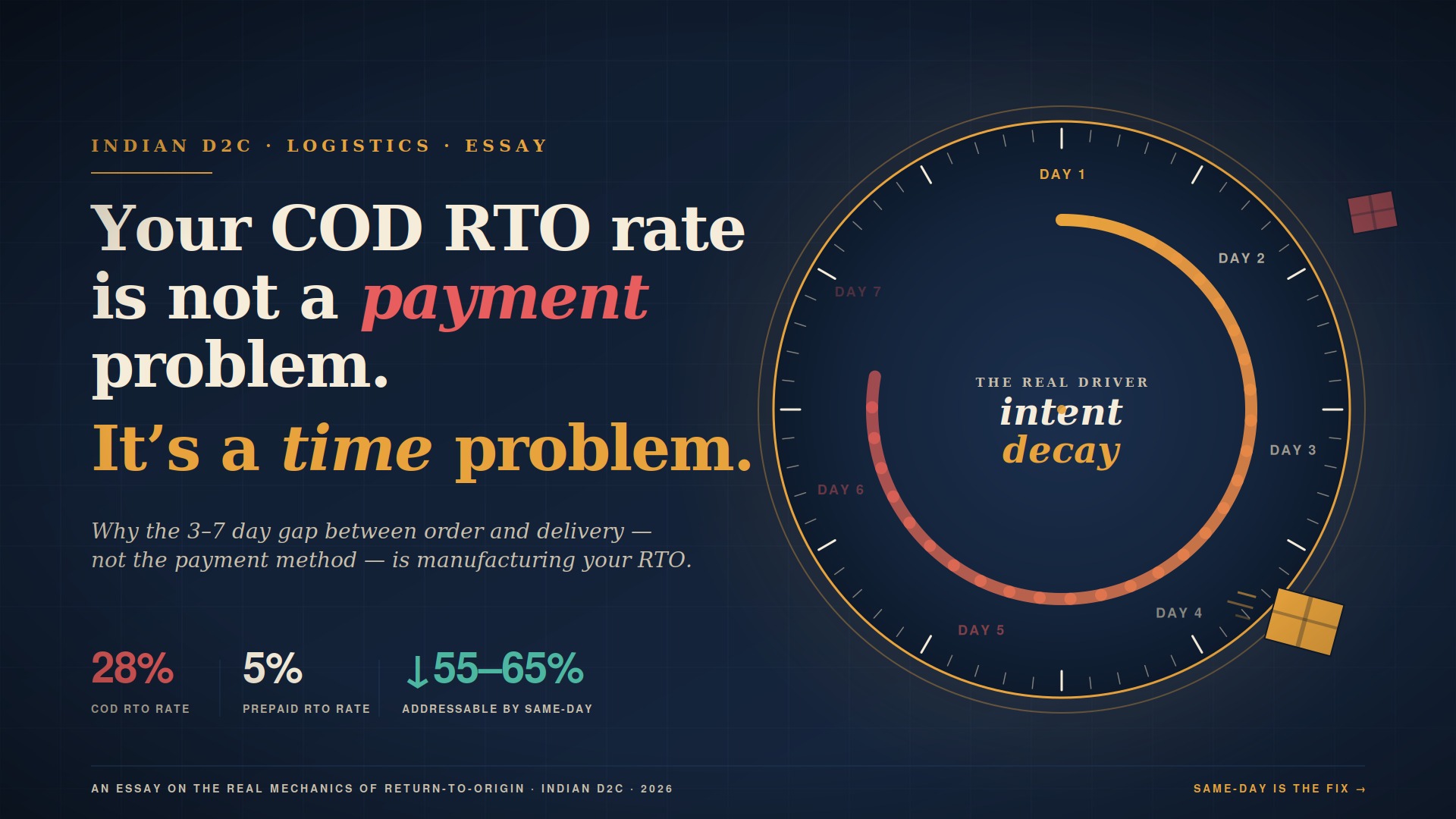 Image: Your COD RTO Rate Is Not a Payment Problem, It's a Time Problem
The payment method is a proxy. What COD actually represents, in the Indian D2C context, is a 3-to-7 day gap between the moment a customer decided to buy and the moment the delivery agent shows up at their door. That gap is where your RTO is being manufactured — not at the checkout, and not at the customer's door.
Understanding this distinction is not academic. It points directly to a solution that most RTO-reduction strategies completely ignore.
What Is Actually Happening Between Order and Delivery
Picture the sequence. A customer is scrolling Instagram at 7pm on a Tuesday. An ad for a kurta, a supplement, a pair of sneakers stops them. The product looks right. The price feels reasonable. They place a COD order — no payment required — and go to sleep.
The brand dispatches the order on Wednesday morning. It moves through a logistics hub in their city, gets sorted, handed to a Tier 2/3 carrier on Thursday, and goes out for first delivery attempt on Friday afternoon. The customer is at work. NDR: customer unavailable. Second attempt: Monday. The customer finally receives it — or refuses it — five days after they ordered.
Now ask: what happened to that customer's relationship with the product between Tuesday night and Monday afternoon?
They may have found the same product cheaper on Meesho on Wednesday. They may have received a different order they had already forgotten about placing, which absorbed the budget they had mentally set aside. They may have shown the Instagram ad to their partner on Wednesday morning and been talked out of it. They may simply have cooled off — the late-night impulse that felt compelling at 10pm looks different in daylight.
None of this is fraud. None of it is malice. It is just the ordinary attrition of human desire over time. And every day of delay is another day in which that attrition compounds.
This is intent decay. It is the real driver of COD RTO in India, and it is almost never named directly.
Why the Payment Method Correlates But Does Not Cause
The reason prepaid orders have a 2–8% RTO rate is not primarily that prepaid customers are better people, or more committed, or more affluent. It is that prepaid customers have already transferred money. That act — completing a payment — changes the psychological relationship with the purchase in two ways.
First, it creates sunk cost. You have paid. The product is yours. The question is no longer "do I want this?" but "when will it arrive?" The mental accounting has closed.
Second, and more importantly for our purposes: prepaid orders are typically fulfilled faster. Brands — consciously or not — prioritize prepaid order dispatch. Payment gateways, instant settlements, and digital confirmation create a faster ops trigger than COD orders, which require more manual handling. So prepaid orders arrive in 1–2 days more often than COD orders, which drift to 4–7 days.
Speed and commitment are confounded. We measure the outcome (RTO rate) and attribute it to the payment method. The more precise attribution is to the delivery timeline.
A thought experiment makes this concrete: if you could deliver every COD order within two hours of placement, what would happen to your COD RTO rate? The customer has not yet had time to reconsider. They almost certainly have the cash — they just ordered. They are almost certainly still at the same address — they ordered an hour ago. They are still in the emotional state that generated the purchase.
The answer, almost certainly, is that your COD RTO rate would collapse toward something close to your prepaid RTO rate.
The "Customer Not Available" Problem Is Far Worse on COD Than Anyone Admits
Here is a structural asymmetry that almost every analysis of Indian delivery failure misses.
When a prepaid order fails its first delivery attempt — the customer is at work, not home, out of town — it is a nuisance. The package can be left at the door in some cases, held at a pickup point, or reattempted the next day with minimal consequence. The customer will receive it eventually because they have already paid and they want it.
When a COD order fails its first delivery attempt, the consequences are qualitatively different. The package cannot be left at the door, or with the security guard, or auntie next-door — it requires a live handover and cash collection. A failed first attempt means rescheduling, another 24 hours of intent decay, a second logistics cost, and a second attempt that may also fail. Each failed attempt is not merely a delay — it is a fresh opportunity for the customer to decide they no longer want the product.
In India's logistics data, "customer unavailable" accounts for approximately 28% of all Non-Delivery Reports (NDRs). But on COD orders, each of those unavailability events is roughly three times more consequential than on prepaid orders, because there is no way to complete the transaction without the customer present with cash in hand.
In India's logistics data, "customer unavailable" accounts for approximately 28% of all Non-Delivery Reports (NDRs). But on COD orders, each of those unavailability events is roughly three times more consequential than on prepaid orders, because there is no way to complete the transaction without the customer present with cash in hand.
Same-day or same-hour delivery does not just reduce "customer unavailable" rates — though it does that dramatically, since the customer is almost certainly still at the location they were at when they ordered. It also eliminates the compounding effect of repeat failed attempts on a declining intent curve.
How Same-Day Delivery Attacks Each of the Major COD RTO Causes
COD RTO has three primary causes in the Indian D2C context. Same-day delivery addresses all three.
Intent decay. As described: collapsed entirely. If the package arrives within hours of the order, there has been no time for regret, competitive discovery, or impulse cooling. The emotional context of the purchase is still active. This is the largest and most underappreciated mechanism.
Customer unavailability. A customer who ordered an hour ago is almost certainly still where they were when they ordered. The probability of genuine unavailability on a same-day delivery is dramatically lower than on a 4-day delivery window. And because same-day delivery by definition involves a narrow delivery window, the customer can be notified — "your order is 20 minutes away" — in a way that 4-day logistics cannot replicate.
Fake delivery attempts. This is a structural feature of the Indian logistics system that brands have little direct control over: delivery agents, under route and volume pressure, mark packages as "attempted, customer unavailable" without actually attempting delivery. Industry estimates suggest 12–15% of all unsuccessful deliveries are fraudulent in this way. Same-day delivery, with its compressed logistics cycle, substantially reduces this problem. The hub-space-clearing behavior that drives fake attempts operates on a 24-to-48-hour batch cycle. Same-day operations do not give that cycle room to develop in the same way. The accountability is higher when the delivery window is measured in hours rather than days.
The Practical Implication
For any D2C brand operating in markets where same-day or same-hour delivery is operationally feasible, the calculus is straightforward: the RTO savings from eliminating intent decay on COD orders will, in almost every realistic scenario, exceed the incremental cost of faster logistics.
The question is not whether same-day delivery reduces COD RTO. The mechanism is clear and the logic is direct. The question is the cost differential between same-day and standard delivery, and whether that differential is covered by the RTO savings.
For most brands doing significant COD volume in urban and semi-urban markets — where same-day infrastructure is increasingly available — the answer is yes, by a wide margin.
The Indian D2C industry has spent considerable energy building smarter checkout flows, risk-scoring algorithms, and NDR management tools. All of that work is valuable. But the most direct intervention against the largest cause of COD RTO — the time gap that decays buyer intent before the product arrives — has been largely absent from the conversation.
What the Numbers Say
The magnitude of the opportunity is significant. Consider a brand doing 10,000 COD orders per month at a 28% RTO rate:The magnitude of the opportunity is significant. Consider a brand doing 10,000 COD orders per month at a 28% RTO rate:
- 2,800 RTOs per month
- At ₹210–280 all-in cost per RTO: ₹5.9–7.8 lakh in monthly logistics waste, before the lost gross margin
- Annual: ₹70–94 lakh in identifiable logistics losses alone
If same-day delivery collapses the intent-decay and availability components of that RTO rate — conservatively accounting for perhaps 55–65% of the total — the addressable reduction is 15–18 percentage points of RTO, taking the brand from 28% toward 10–13%.
On the same 10,000 monthly COD orders, that is the difference between 2,800 RTOs and 1,000–1,300 RTOs. A saving of 1,500–1,800 orders per month, at ₹210–280 per order: ₹31.5–50 lakh saved every month. Annually, ₹3.8–6 crore in recovered logistics cost, before accounting for the recovered gross margin on orders that now successfully deliver, and the pixel data improvement that reduces CAC.
Try our calculator here: if you can reduce your COD RTO rate by 15 percentage points, how much would that save you in logistics costs and recovered gross margin?
These are conservative estimates. They assume same-day delivery does not touch the remaining causes of COD RTO (genuine product refusal, address errors, fraud). In practice, addressing intent decay and customer availability eliminates the majority of the economically significant RTO volume — the preventable failures.
Why This Argument Is Not Being Made
The RTO conversation in Indian D2C has been dominated, understandably, by the payment method frame. The industry's response has been to build tools that manage COD risk at checkout: risk scoring, partial payment requirements, OTP verification, COD fees in high-risk zones, one-page checkout solutions that push customers toward prepaid.
These tools work. They are legitimate interventions that materially reduce RTO. But they all operate on the same underlying model: the problem is the customer's commitment level, and the fix is to filter or modify customer behavior at the point of purchase.
The time-problem frame offers a different model: the problem is the window between purchase and delivery, and the fix is to close that window. This intervention operates not on the customer's psychology at checkout but on the logistics system itself.
The two approaches are complementary, not competing. Checkout-based interventions and same-day delivery both reduce COD RTO. But same-day delivery attacks the problem at its structural root — the intent decay mechanism — in a way that no checkout tool can replicate.
The Practical Implication
The question is not whether same-day delivery reduces COD RTO. The mechanism is clear and the logic is direct. The question is the cost differential between same-day and standard delivery, and whether that differential is covered by the RTO savings.
For most brands doing significant COD volume in urban and semi-urban markets — where same-day infrastructure is increasingly available — the answer is yes, by a wide margin.
The Indian D2C industry has spent considerable energy building smarter checkout flows, risk-scoring algorithms, and NDR management tools. All of that work is valuable. But the most direct intervention against the largest cause of COD RTO — the time gap that decays buyer intent before the product arrives — has been largely absent from the conversation.
For any D2C brand operating in markets where same-day or same-hour delivery is operationally feasible, the calculus is straightforward: the RTO savings from eliminating intent decay on COD orders will, in almost every realistic scenario, exceed the incremental cost of faster logistics.
Same-day delivery is not just a customer experience upgrade. For COD-heavy D2C brands in India, it is a margin recovery mechanism.
Sources: IIMA Survey, February 2024 (COD share of Indian e-commerce); Pragma / Bepragma.ai (NDR cause analysis, RTO rate benchmarks); Shipyaari (fake delivery attempt estimates); GoSwift (NDR breakdown by cause); ET Prime Research (COD RTO rates)